How Many Legs Does a Centipede Have?
Anywhere from 30 to 382 — but, despite the name, never exactly 100. Centipedes carry one pair of legs per body segment and always have an odd number of pairs, from 15 up to 191. So "hundred-legged" is a name no centipede actually lives up to.
Build a centipede
Drag the segments. One pair of legs per segment — and the number of pairs is always odd.
Notice the gap: you can build 98 legs or 102, but the slider can never stop on 100. That isn't a quirk of the tool — it's the actual biology.
The answer — and why never 100
A centipede's body is a chain of segments, and nearly every segment carries exactly one pair of legs. Count the pairs across all known species and they range from 15 pairs to 191 pairs — so a total of 30 to 382 legs, depending on the species. The common house centipede sits at the bottom of that range with 15 pairs; soil centipedes climb to the top.
The famous catch is in the maths. The number of leg pairs is always odd — 15, 17, 21, 23, and so on. A hundred legs would need 50 pairs, an even number, which simply never occurs. The closest any centipede gets is 49 pairs (98 legs) or 51 pairs (102 legs). The Latin "centi-" promises a hundred; the animal politely declines.
One more twist: a centipede's foremost "legs" aren't for walking. The first pair is modified into venomous claws called forcipules, tucked under the head — they're how a centipede injects venom, and they're technically legs, not fangs.
The centipede in your bathroom
The fast, leggy blur darting across a bathroom or basement floor is almost always the house centipede (Scutigera coleoptrata) — pale grey-yellow, about 25–38 mm long, with 15 pairs of strikingly long legs (30 in all). It heads indoors looking for damp and, more importantly, for prey.
Unsettling as it looks, it's harmless and arguably an ally: house centipedes hunt cockroaches, silverfish, spiders, bed bugs and other household pests. An exterminator's real advice is usually to fix the moisture and the insects it's feeding on — remove its food and damp hiding spots and the centipede leaves on its own. It rarely bites people, and its jaws often can't even break human skin.
Centipede vs millipede
They're constantly confused, but one feature settles it instantly: count the legs per segment. A centipede has one pair per segment; a millipede has two, giving millipedes that dense, ripple-like fringe. Centipedes are flattened, fast and predatory; millipedes are rounder, slow, and eat decaying plant matter, curling into a spiral when disturbed.
And the names mislead both ways. No centipede reaches 100 legs — and no millipede reaches 1,000, though one species, Eumillipes persephone, was found with over 1,300, finally living up to the "thousand-legged" name. The leggiest animals on Earth are all millipedes; centipedes win on speed, not count.
Are centipede bites dangerous?
All centipedes are venomous — that's what the forcipules deliver — but for the species most people meet, a "bite" is minor. House and stone centipedes rarely pierce skin, and when they do it usually feels like a mild bee sting that fades within hours. They aren't poisonous to touch, and they don't sting with their tails.
The large tropical species are a different matter: a bite from a giant Scolopendra is genuinely painful, with swelling that can last a day or two. Serious complications are rare but possible, especially for anyone with an allergy. As general guidance, clean the area and manage pain and swelling — and seek medical care if you have a severe reaction, signs of infection, or were bitten by a large exotic species.
The giants that eat mice
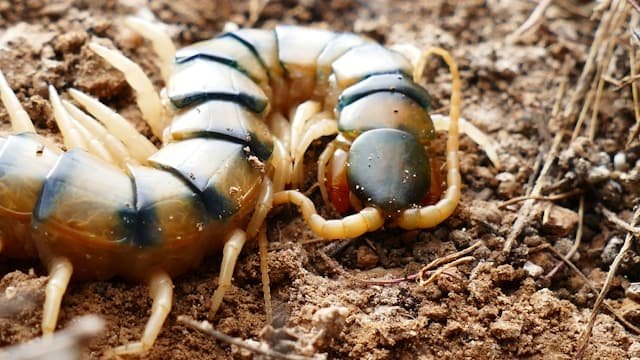
The largest centipede in the world is the Amazonian giant centipede (Scolopendra gigantea), which can exceed 30 cm (12 inches). It has only 21 or 23 leg pairs — far fewer than a tiny soil centipede — but each leg is huge. It's a formidable hunter, taking insects, spiders, lizards, frogs, mice and even bats, which it plucks from cave ceilings while anchoring itself by a few rear legs.
So "most legs" and "biggest" point to opposite ends of the family: the leggiest centipedes are small burrowers with up to 382 tiny legs, while the giants make do with under 50 large ones.
The other "centipedes"
Search "centipede" and you'll also hit things that aren't bugs. Centipede the arcade game is an Atari classic from 1981, co-designed by Dona Bailey — one of the first women to design a coin-op arcade game — in which you blast a centipede winding down through a field of mushrooms.
And The Human Centipede is a notorious horror trilogy from Dutch director Tom Six (2009–2015). If you're counting in those films, the grim "how many" is people, not legs: the first film links 3 victims, the second 12, and the third a claimed 500. Very much a different kind of centipede math — and not for the squeamish.
Common questions
Game: centipede or millipede?
Five traits, two suspects. One pair of legs per segment is your biggest clue.
Eats decaying leaves and rotting wood
Sources
- Australian Museum & Missouri Dept. of Conservation — leg pairs always odd, 15–191 pairs (30–382 legs); one pair per segment.
- Wikipedia, "Centipede" — no species has exactly 100 legs; forcipules are modified legs that deliver venom.
- Snopes / National Library of Medicine (2017) — odd-pair rule confirmed; Scolopendromorpha 21–23 pairs, Geophilomorpha up to 191.
- Wikipedia, "Scolopendra gigantea" — largest centipede, exceeds 30 cm, 21–23 segments, preys on mice and bats.
- Pest references (PestWorld, Aptive) — house centipede Scutigera coleoptrata, 15 pairs / 30 legs; beneficial predator indoors.
More leg-counting
Thirty legs or three hundred and eighty-two — just never the hundred its name keeps promising.