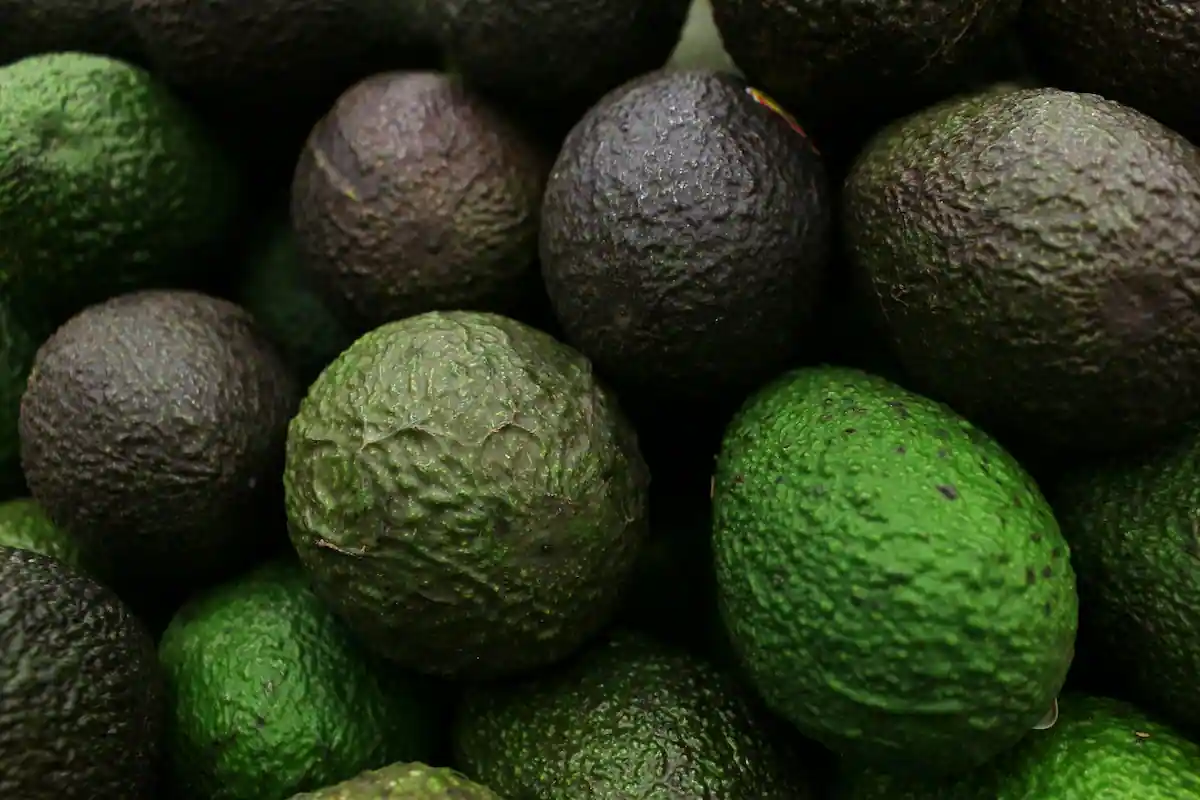
A whole medium Hass avocado holds about 240 calories (~1,000 kJ); per 100 g it's about 160, and half is roughly 110. But the real story is where those calories come from: an avocado stores its energy as oil, so about 80% of its calories are fat — and that means the variety you buy changes the number.
Avocado calorie calculator
USDA dataThe calories are the oil — watch the "from fat" figure, and switch variety to see it move.
USDA averages for plain flesh. A Florida "Slimcado" holds far less oil than a Hass — same fruit, very different calories.
Advertisement
AdSense Slot: content_top
The short answer — and why it swings
USDA figures put avocado at 160 calories per 100 g of flesh. The catch is that avocados vary enormously in size, so the calories in "an avocado" run from about 110 for half a small one to 320+ for a large whole fruit. A standard half-fruit serving is around 110 calories; a whole medium Hass, roughly 240. Because the size varies two- or three-fold, a calculator beats a single headline number.
Calories by portion
| Portion | Calories | Kilojoules | Fat |
|---|---|---|---|
| 100 g | 160 cal | 669 kJ | 15 g |
| ⅓ fruit (50 g) | 80 cal | 335 kJ | 7 g |
| Half (68 g) | 109 cal | 456 kJ | 10 g |
| Whole medium Hass (150 g) | 240 cal | 1,004 kJ | 22 g |
| Large Hass (200 g) | 320 cal | 1,339 kJ | 30 g |
| Whole Florida (200 g) | 240 cal | 1,004 kJ | 16 g |
Note the last two rows: a whole Florida avocado the same weight as a large Hass carries ~80 fewer calories.
An avocado is a fruit that stores oil, not sugar
Most fruit banks its energy as sugar; the avocado is the oddball that banks it as fat. That single fact explains its whole calorie profile. Of the ~15 g of fat per 100 g, almost all the calories follow, because fat packs 9 calories per gram against just 4 for carbohydrate. Run the maths and roughly 80% of an avocado's calories are fat — which is why it carries about five times the calories of a comparable weight of apple or orange. The fat itself is mostly oleic acid, the same monounsaturated fat that dominates olive oil, linked to better cholesterol and lower inflammation. When you ask "how many calories in an avocado," you're really asking "how much oil is in this one."
The variety changes the calories
Because the calories are the oil, anything that changes the oil content changes the count — and variety does exactly that. The creamy Hass (California-style) is the fatty benchmark at ~160 cal/100 g. The big, glossy green Florida avocado — marketed as the "Slimcado" — is grown in a wetter climate, so it holds more water and far less oil: roughly 30% fewer calories and up to half the fat of a Hass. It's the same fruit family producing wildly different numbers, which is rare in food. The trade-off is texture: less oil means less of the buttery creaminess Hass is loved for.
Advertisement
AdSense Slot: content_mid
You're almost certainly eating one tree
Here's the part that surprises people. There are hundreds of avocado cultivars, but a single one — Hass — makes up around 80% of avocados worldwide and about 95% of the US market. And every Hass avocado on Earth traces back to one tree: a seedling grown by a postman named Rudolph Hass in La Habra Heights, California, in the late 1920s, patented in 1935. Every Hass since has been grafted from that lineage — clones of the original. The mother tree finally died of root rot in 2002. So "a couple of varieties" isn't loose talk: practically speaking, the avocado in your kitchen is one variety, propagated from one tree.
Net carbs, fibre and nutrient absorption
For all that fat, avocados are very low in usable carbohydrate. Of the ~8.5 g of carbs per 100 g, about 6.7 g is fibre, leaving under 2 g of net carbs — which is why they're a staple of keto and low-carb eating. They also carry more potassium per gram than a banana, and their fat does double duty: the fat-soluble vitamins A, D, E and K need dietary fat to be absorbed, so adding avocado to a salad measurably increases how many of the other ingredients' nutrients your body takes up.
Frequently asked
How many calories are in an avocado?
A whole medium Hass avocado (about 150 g of flesh) has roughly 240 calories (around 1,000 kJ). Per 100 g it's about 160 calories. Half an avocado is about 110 calories. Larger fruit can top 320.
How many calories in half an avocado?
About 110 calories (≈460 kJ) for half a medium Hass avocado (~68 g of flesh), with roughly 10 g of fat and 4–5 g of fibre.
Why are avocados so high in calories?
Because they store energy as oil rather than sugar. About 80% of an avocado's calories come from fat, and fat carries 9 calories per gram versus 4 for carbohydrate — so an avocado has roughly five times the calories of most other fruit.
Do Florida and Hass avocados have different calories?
Yes, markedly. A Florida or 'Slimcado' avocado is grown in a wetter climate, holds more water and far less oil, and has roughly 30% fewer calories and up to half the fat of a creamy Hass.
Is avocado good for a low-carb or keto diet?
Yes. Of its ~8.5 g of carbohydrate per 100 g, about 6.7 g is fibre, leaving under 2 g of net carbs — very low, while supplying heart-healthy monounsaturated fat.
What kind of fat is in an avocado?
Mostly oleic acid, a monounsaturated fat — the same fat that makes up the bulk of olive oil — which is linked to better cholesterol levels and reduced inflammation.
Sources
- USDA FoodData Central — raw avocado ~160 cal, 14.7 g fat, 8.5 g carbohydrate (6.7 g fibre), 2 g protein per 100 g.
- Florida / "Slimcado" (West Indian) avocado — roughly 30% fewer calories and ~half the fat of Hass (Brooks Tropicals; horticulture sources).
- Hass origin — single mother tree grown by Rudolph Hass, La Habra Heights, CA (late 1920s; patented 1935; tree died 2002); ~95% of the US avocado market.
- Fat at 9 calories per gram vs 4 for carbohydrate; oleic acid as the dominant monounsaturated fat.
Advertisement
AdSense Slot: content_bottom
Related
Ask how many calories are in an avocado and you're really asking how much oil it stored — and, almost always, you're asking about one tree's descendants.