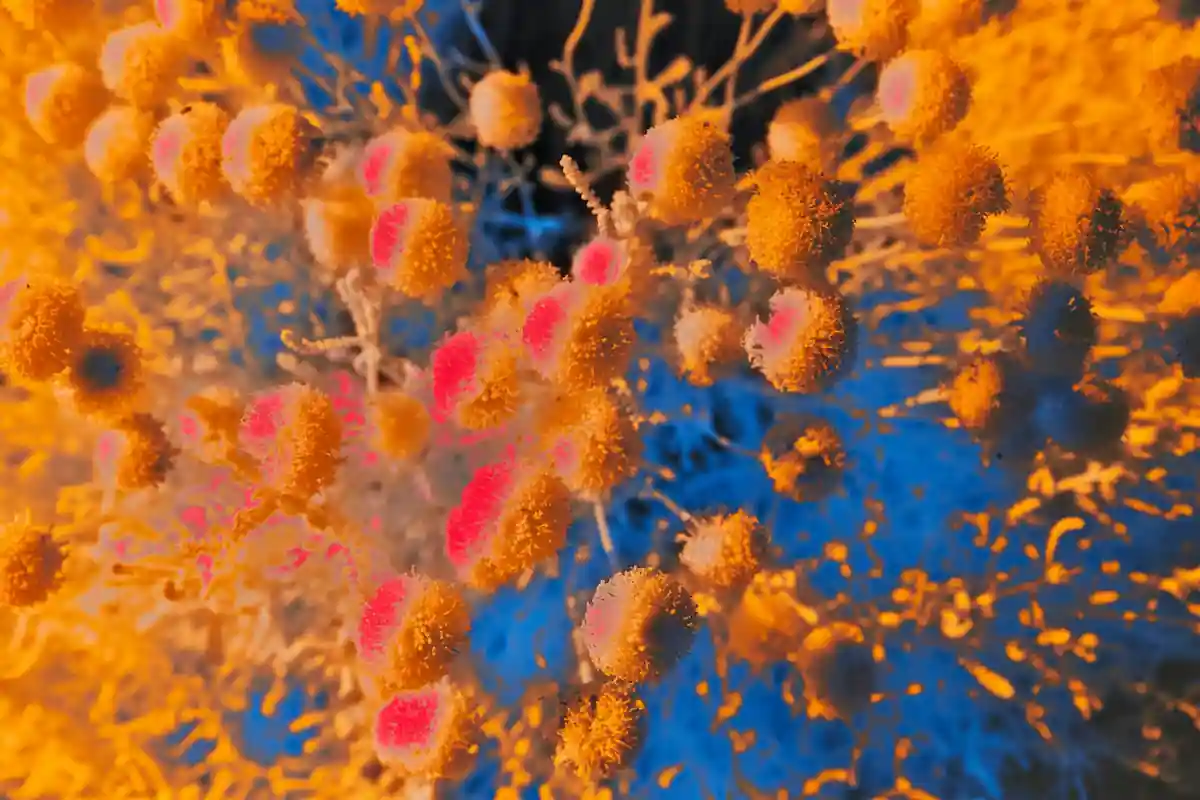
About 36 trillion in an adult male, 28 trillion in an adult female, 17 trillion in a 10-year-old child — the current best estimate, from Hatton et al. in PNAS, September 2023. The famous "37.2 trillion" figure most pages still quote is from a 2013 paper that didn't separate sexes.
Quick answer
Roughly 30 trillion human cells — call it 36T for a typical adult man, 28T for a woman, 17T for a child. Plus about the same number of bacteria (not ten times more, which was an old textbook myth).
Two-thirds to four-fifths of those cells are red blood cells.
How many cells in your body?
PNAS 2023 figuresPick a body type, then nudge the weight slider.
Linear scaling from the PNAS reference body (70 kg M / 60 kg F / 32 kg child). Real range is wider — body composition matters too.
Advertisement
AdSense Slot: content_top
Why the number keeps being revised
For most of the 20th century, biology textbooks gave numbers from "tens of billions" to "100 trillion" and the truth was that nobody had actually counted. A 2013 paper by Bianconi et al. in Annals of Human Biology was the first serious census — it landed on 37.2 trillion by adding up estimates organ by organ. That's the figure that ended up everywhere.
In September 2023, Ian Hatton and colleagues published a more thorough recount in PNAS, drawing on over 1,500 sources and 400 cell types across 60 tissues. They separated reference bodies by sex and age, giving us the three numbers above. They also found a tidy mathematical pattern: cell size and cell count trade off inversely, so every "size class" of cell contributes roughly the same total mass.
The bacteria myth
For decades you'd read that bacteria in and on the human body outnumber human cells 10 to 1. In January 2016, Ron Sender, Shai Fuchs and Ron Milo at the Weizmann Institute published a careful re-estimate in PLOS Biology: the real ratio in a reference 70-kg man is closer to 1.3:1 bacteria to human cells — basically a draw. A single trip to the toilet can flip the ratio briefly the other way.
Why counting cells feels backwards
The body's count is dominated by one tiny cell type, but the body's mass is dominated by entirely different ones. A red blood cell is about 8 µm wide and lasts ~120 days. A mature fat cell is ~50–150 µm — roughly five thousand times bigger by volume. A single skeletal muscle fibre is in a different league again: one fibre can be 30 cm long, contains thousands of nuclei, and counts as one cell. So adding muscle and fat to the count barely shifts it; adding them to the mass changes nearly everything.
This is the central finding of the Hatton 2023 paper: across the body's ~1,200 cell groups, cell size and count trade off so precisely that every "size class" of cell contributes roughly the same total biomass. The table below makes the inversion concrete — read the count column, then the mass column, and watch the picture flip.
| Cell type | Count | % of count | Mass | % of mass |
|---|---|---|---|---|
| Red blood cells (erythrocytes) 90 µm³ (≈8 µm wide) | ~25 trillion | ~84% | ~3 kg | ~4% |
| Platelets tiny (2–3 µm) | ~1.5 trillion | ~5% | ~10 g | <0.1% |
| Bone marrow cells 15–20 µm | ~750 billion | ~3% | ~2.5 kg | ~4% |
| Vascular endothelial cells 10–20 µm | ~600 billion | ~2% | ~1 kg | ~1% |
| Lymphocytes 8–12 µm | ~500 billion | ~2% | ~100 g | <1% |
| Skin cells ~30 µm | ~250 billion | ~1% | ~4 kg | ~5% |
| Neurons + glia cell body 5–50 µm; axons up to 1 m | ~170 billion | <1% | ~1.4 kg | ~2% |
| Adipocytes (fat cells) 50–150 µm (5,000× an RBC) | ~30 billion | 0.1% | ~15 kg | ~20% |
| Skeletal muscle fibres up to 30 cm long, multinucleated | ~250 million | 0.001% | ~28 kg | ~40% |
Reference 70-kg adult male. Figures are order-of-magnitude — synthesised from Hatton et al. 2023, Bianconi 2013, and standard reference values. Skeletal muscle "fibre count" is the count of intact multinucleated fibres, not nuclei; counting nuclei pushes muscle's share of count up to several hundred billion but still leaves the headline intact: a quarter of the body's mass, a sliver of its cell count.
The single most surprising row is the last one. Skeletal muscle is roughly 40% of body weight but contains only a few hundred million distinct fibres — fewer cells than the population of the United States. Fat is the same story, scaled down: ~15 kg of tissue but only ~30 billion adipocytes, because each fat cell is enormous compared to a red blood cell.
How many cell types
The traditional answer is ~200. That figure is being overtaken in real time by the Human Cell Atlas, a consortium launched in 2016 (chaired by Aviv Regev and Sarah Teichmann) using single-cell RNA sequencing to profile every cell type in the body. The current map already lists more than 400 distinct types, and finer subtypes are still being added. By any honest definition the answer is "around 200, and growing."
How fast cells turn over
Your body produces roughly 3–4 million new cells per second just to keep pace with loss. Different tissues replace at very different speeds: the lining of your small intestine is renewed every 3–5 days, red blood cells every ~120 days, skeletal muscle nuclei rarely. Many neurons in the cerebral cortex are with you for life — work by Jonas Frisén's lab at Karolinska in the 2000s using nuclear-bomb-era carbon-14 dating showed cortical neurons don't measurably replace.
Biggest, smallest, longest
- Largest by volume — the human egg (ovum), about 100 µm across. Just visible to the naked eye.
- Smallest — the sperm cell head, around 5 µm.
- Longest — motor neurons running from the base of the spine to the toes. In a tall adult, a single axon can be ~1 metre long.
- Most numerous — red blood cells, by a country mile.
Advertisement
AdSense Slot: content_mid
Frequently asked
How many cells in an adult body?
About 36 trillion in a 70-kg male, 28 trillion in a 60-kg female — the current best estimates from PNAS 2023, replacing the older single figure of 37.2 trillion.
How many cells in a child's body?
About 17 trillion in a typical 10-year-old. The figure scales roughly with body mass within a given body type.
Do larger people have more cells, or bigger cells?
More cells. Cell size for any one type is tightly constrained — bigger bodies are built with extra cells, not bigger ones.
How many cell types are there?
~200 by the traditional listing, more than 400 in the Human Cell Atlas single-cell sequencing data, and rising as finer subtypes are identified.
Is it really 1:1 bacteria to human cells, or just bacteria-rich gut?
Most of the body's bacteria sit in the large intestine. Over the whole body, the ratio averages around 1.3 bacteria to 1 human cell — close enough to call it 1:1.
How many cells does the body make per second?
Roughly 3–4 million, replacing the same number that die. The intestinal lining and bone marrow are the busiest factories.
Sources
- Hatton IA, Galbraith ED, Merleau NSC, Miettinen TP, Smith BM, Shander JA (Sep 2023) — The human cell count and size distribution, PNAS 120(39). 36T male / 28T female / 17T child.
- Bianconi E et al. (2013) — An estimation of the number of cells in the human body, Annals of Human Biology 40(6). The 37.2 trillion figure.
- Sender R, Fuchs S, Milo R (Jan 2016) — Revised estimates for the number of human and bacteria cells in the body, PLOS Biology. Bacteria:human ≈ 1.3:1.
- Spalding KL, Bhardwaj RD, Buchholz BA, Druid H, Frisén J (2005) — Cell 122. Carbon-14 dating of human cell turnover; cortical neurons as lifelong cells.
- Human Cell Atlas project (humancellatlas.org) — 400+ cell types and counting.
- Live Science, Sept 2023 — coverage and quotes from Ian Hatton on the PNAS results.
Advertisement
AdSense Slot: content_bottom
Related questions
About thirty trillion of you, give or take, and roughly the same number of bacterial passengers. Most of the count is one tiny disc-shaped courier carrying oxygen.